
In the field of optics, lenses are indispensable optical components with an exceptionally broad range of applications—from everyday eyeglasses to cutting-edge scientific instruments. At their core, lenses manipulate light by exploiting the refractive properties of transparent materials; through precisely engineered surface geometries, they control light rays to converge, diverge, or form images.

Principles of Lens Operation
The physical foundation of lens operation is Snell’s Law—the fundamental law of refraction. When light travels from one medium into another, its direction changes due to the difference in refractive indices between the two media and the angle at which it strikes the interface. Lenses are typically fabricated from transparent materials such as glass or plastic—both of which possess higher refractive indices than air—resulting in significant bending of incident light. For instance, standard optical glass exhibits a refractive index ranging from approximately 1.5 to 1.8, whereas air’s refractive index is nearly 1.
Lens Classification and Characteristics
Convex Lenses (Converging Lenses)
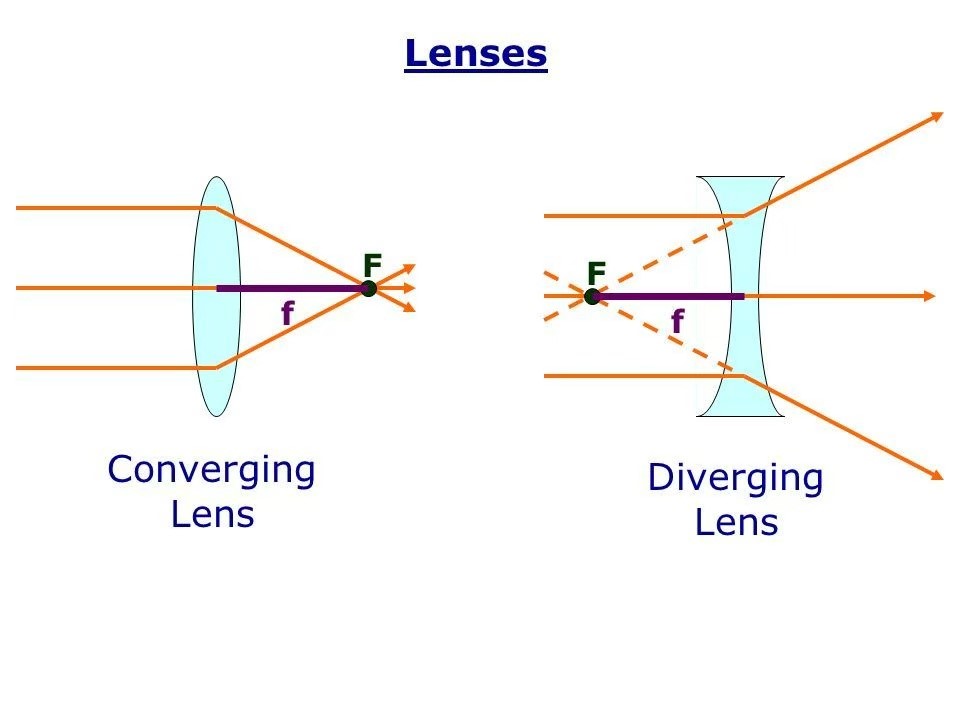
Convex lenses are thicker at the center and thinner at the edges. Common variants include biconvex, plano-convex, and meniscus (convex-concave) lenses. When parallel light rays strike a convex lens, they refract and converge at a focal point on the opposite side, enabling both real and virtual image formation. These lenses offer several key functionalities: their ability to concentrate light makes them ideal for spotlights and solar concentrators; their magnifying capability is harnessed in simple magnifiers; and they serve as essential elements in high-performance optical systems—including microscope objectives and camera lenses.
Concave Lenses (Diverging Lenses)
Concave lenses are thinner at the center and thicker at the periphery. Examples include biconcave, plano-concave, and meniscus (concave-convex) lenses. Parallel incident light rays diverge after passing through a concave lens, and their backward extensions intersect at a virtual focal point located on the same side as the incoming light. By spreading out light rays, concave lenses reduce image size and are widely used in corrective eyewear for myopia and in laser beam expanders. In fact, myopic correction relies precisely on this divergence effect—allowing light to focus accurately onto the retina after being appropriately spread.
Specialized Lenses
Beyond conventional convex and concave lenses, specialized designs address unique functional requirements. Gradient-index (GRIN) lenses feature a radially varying refractive index, making them highly effective for beam collimation. Fresnel lenses, with their ultra-thin, segmented structure, deliver strong light-gathering performance while minimizing weight and material usage—ideal for applications like lighthouse projectors and solar concentrators.
Imaging Capabilities of Lenses
Real vs. Virtual Images
Lenses form images by altering the paths of light rays via refraction. A real image arises from the actual convergence of light rays and can be projected onto a screen—for example, the image formed on photographic film or a digital sensor. A virtual image, by contrast, results from the apparent intersection of backward-extended light rays and cannot be captured on a physical surface—such as the enlarged view seen when using a magnifying glass.
Imaging Formula
Lens imaging behavior follows the Gaussian lens formula:
1/f = 1/u + 1/v
where f denotes focal length, u the object distance, and v the image distance. Convex lenses have positive focal lengths, while concave lenses carry negative values. This equation enables precise prediction of image location, size, orientation, and nature—given only the object position and lens focal length.
Aberrations and Correction Strategies
Real-world lenses inevitably deviate from ideal optical behavior due to geometric constraints, material limitations, or design compromises—leading to various types of aberrations. Spherical aberration occurs when axial rays focus at different points due to the spherical curvature of lens surfaces. Coma arises from off-axis rays forming comet-shaped blurs. Astigmatism results when tangential and sagittal rays fail to converge at a common point. Field curvature causes the image plane to bend, degrading sharpness toward the periphery. Distortion manifests as geometric warping—such as barrel or pincushion distortion. Chromatic aberration stems from wavelength-dependent refractive indices, causing color fringing and focal separation across the visible spectrum.
To mitigate these imperfections, optical designers employ several strategies: aspheric lenses provide superior wavefront control and significantly suppress spherical and other monochromatic aberrations; compound lens assemblies—like achromatic doublets—combine multiple elements with complementary dispersion characteristics to cancel chromatic effects; and symmetric optical layouts help balance residual aberrations, enhancing overall image fidelity.
Lens Materials
Material Selection
Lens materials vary widely depending on application-specific demands. Optical glasses—such as K9 and BK7—offer excellent transmission, low dispersion, and robust chemical stability, making them ideal for visible-light systems. Polymers—including PMMA (acrylic) and polycarbonate (PC)—are lightweight and economical but exhibit limited thermal resistance, rendering them suitable primarily for consumer electronics and low-power optical devices. Crystalline materials—like calcium fluoride and fused silica—are employed in ultraviolet or infrared systems where conventional glasses absorb too strongly.
Applications Across Domains
Imaging Systems
Lenses lie at the heart of virtually all imaging systems—serving as the primary optical element responsible for capturing, focusing, and resolving visual information.Cameras use lens assemblies to focus light and produce sharp images; by adjusting the distance between lenses, the focal length can be varied to accommodate both close-up and distant photography. Microscopes magnify minute objects—such as cellular structures—and are indispensable tools in biological research. Telescopes observe celestial bodies at vast distances, enabling exploration of cosmic mysteries and serving as essential instruments in astronomical studies. Projectors likewise rely on lenses to cast images onto screens.
Laser Technology
In laser applications, lenses perform critical functions such as focusing, beam expansion, and collimation. For instance, a lens can concentrate a laser beam into an extremely small spot, significantly increasing its energy density—making it suitable for precision laser machining and similar industrial processes. Beam-expanding lenses increase the diameter of the laser beam to meet diverse application requirements.
Optical Fiber Communications
In fiber-optic systems, coupling lenses efficiently launch optical signals into optical fibers, ensuring high-fidelity, low-loss transmission and thereby enhancing overall communication performance.
Medical Devices
Lenses are integral to numerous medical instruments: endoscopes employ lens systems to visualize internal organs non-invasively, while ophthalmic diagnostic devices use precision optics to measure key ocular parameters—supporting accurate clinical assessment and diagnosis.
Consumer Electronics
In consumer electronics, lenses are embedded in smartphone cameras and VR/AR optical modules alike, delivering users crisp, immersive, and lifelike visual experiences.