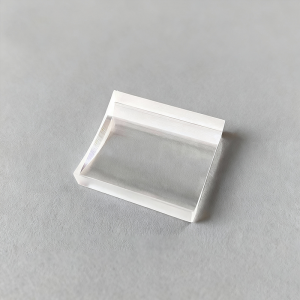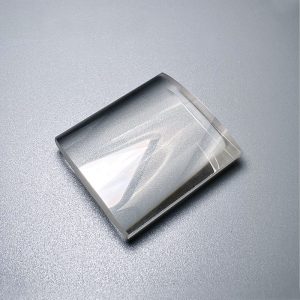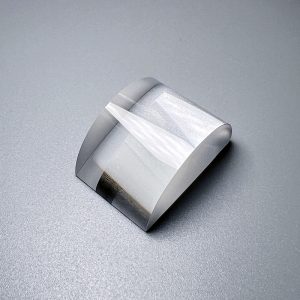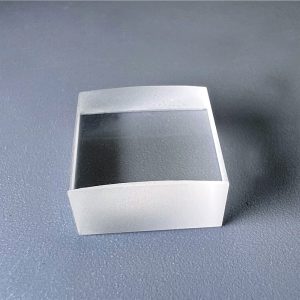
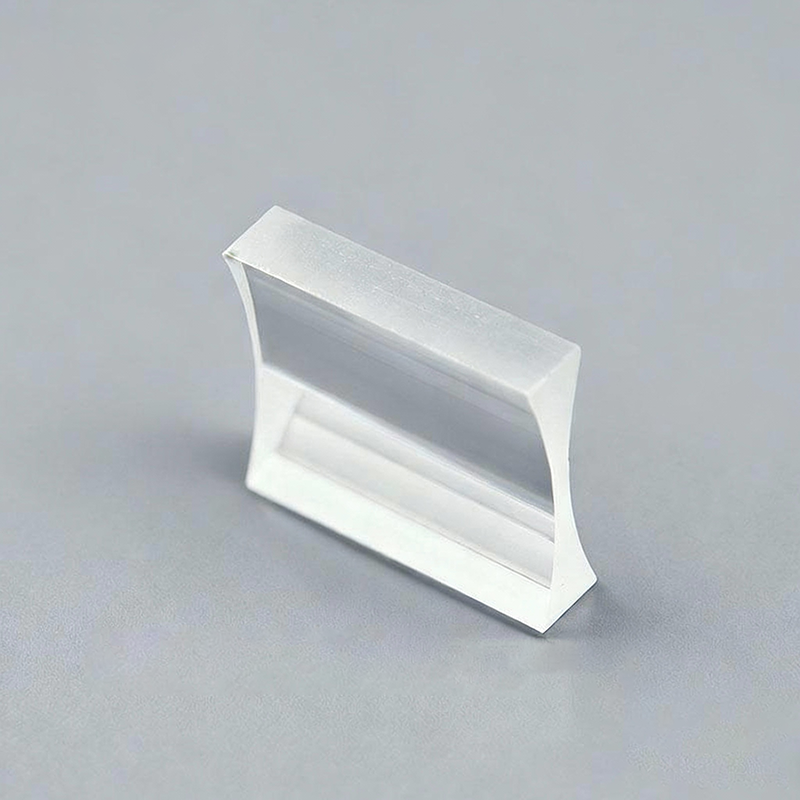
Unlike plano-convex or double-convex cylindrical lenses—which focus or converge light—a double-concave cylindrical lens functions to diverge incident light along a single axis. Its two symmetrically concave surfaces cause parallel incoming rays to spread outward, yielding a negative focal length; effectively acting as a one-dimensional beam expander.
Key Features:
• Divergence Capability: Spreads incident light (e.g., collimated beams) along one dimension only—contrasting with plano-convex and double-convex cylindrical lenses, whose primary function is focusing or convergence.
• One-Dimensional Beam Shaping: Alters ray propagation exclusively in the direction perpendicular to the cylinder axis, leaving the orthogonal direction unaffected—enabling conversion of a point spot into a line spot.
• Aberration Compensation: Useful for correcting specific aberrations in optical systems, especially when integrated with other lenses.
• Negative Focal Length: A defining optical characteristic distinguishing it from converging cylindrical lenses (e.g., double-convex or plano-convex types).
| Material | K9 glass, fused silica, etc. |
| Diameter Tolerance | ±0.02mm |
| Thickness Tolerance | ±0.02mm |
| Surface Figure | λ/10 |
| Surface Quality | 20/10 or better |
| Centration Error | <3 arc min |
| Clear Aperture | >90% |
| Edge Chamfer | <0.2X45° |
| Coating | Customizable |