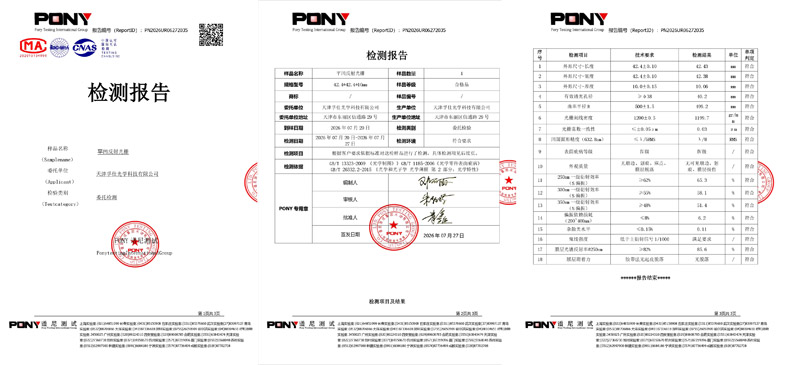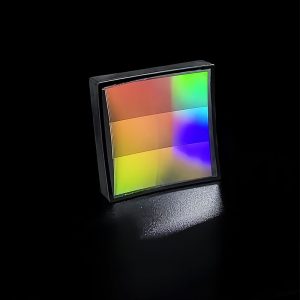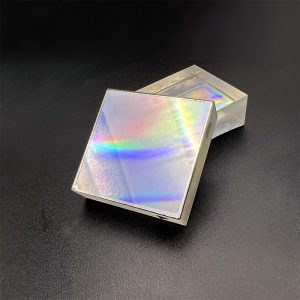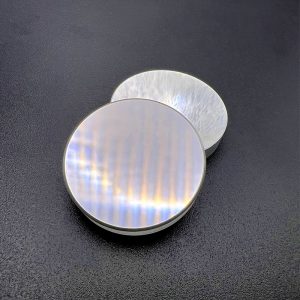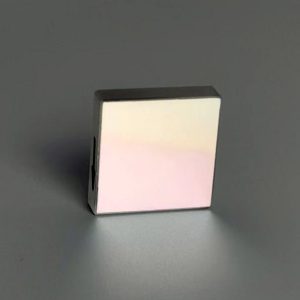
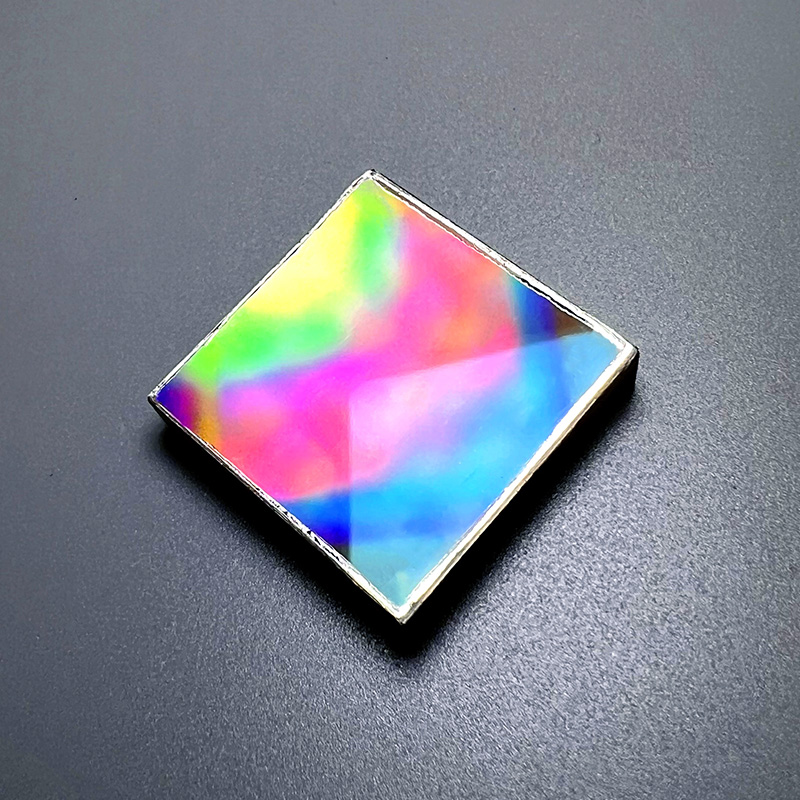
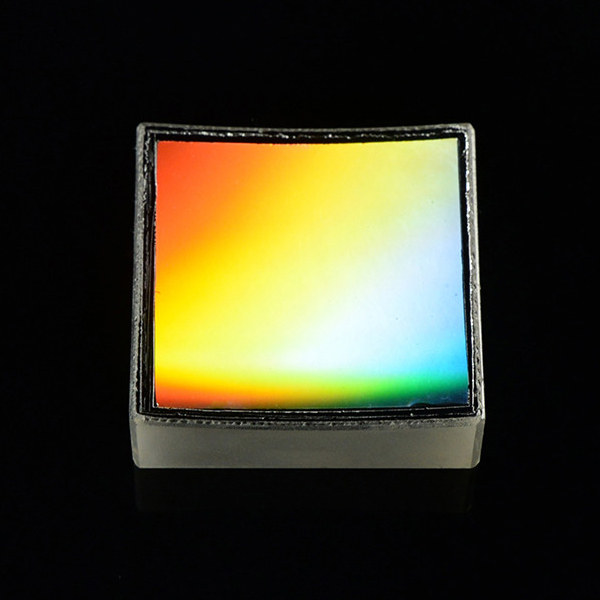
The plane ruled diffraction grating is a fundamental dispersive optical component. It precisely decomposes incident polychromatic light—such as white light—into its spectral components, spatially spreading them in order of wavelength to produce a continuous spectrum. This capability forms the cornerstone of high-resolution spectrometers, monochromators, and diverse spectroscopic systems.
Manufacturing involves two key stages: master grating fabrication and vacuum replication.
Master Grating Ruling: Under ultra-precision conditions, a diamond stylus mechanically scribes sawtooth-shaped grooves onto an atomically smooth aluminum-coated substrate. The groove spacing and blaze angle—both critically defined during ruling—directly govern the grating’s dispersion characteristics and optical efficiency. This step represents both the origin and the performance benchmark for all subsequent replicas.
Vacuum Replication: A release layer and highly reflective aluminum coating are first deposited onto the master grating surface. A glass substrate pre-coated with epoxy resin is then brought into intimate contact, cured under controlled conditions, and finally separated—yielding a faithful, high-fidelity replica. This process enables efficient, large-scale production of gratings with consistent, top-tier optical performance.
This hybrid approach—combining cutting-edge precision with scalable manufacturing—serves as the foundation for both research-grade and industrial-grade diffraction gratings.