
In sophisticated optical systems, not all light paths travel in straight lines. When space is limited, beams need to change direction, or light must be split, prisms step in as dependable “turn coordinators” in optical path design. Leveraging total internal reflection, they nimbly redirect light paths—and, like master magicians, disperse composite light into vivid, colorful spectra.
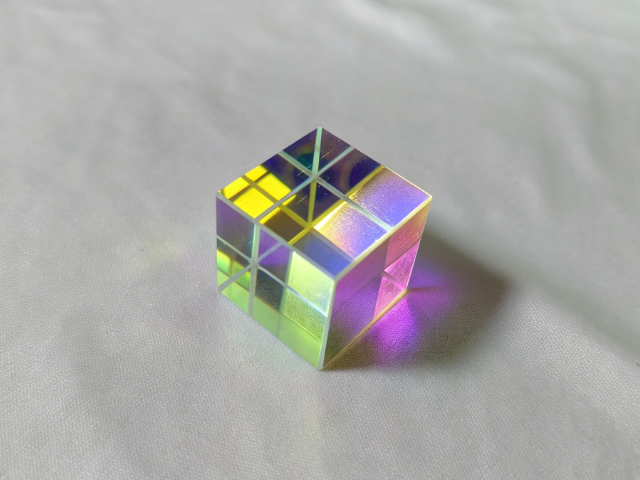
1. What Is a Prism?A prism is a transparent optical component formed by two or more intersecting optical planes, typically fabricated from optical glass, fused silica, or crystalline materials.
Core Operating Principle: Light-path manipulation is achieved primarily through refraction and total internal reflection (TIR).
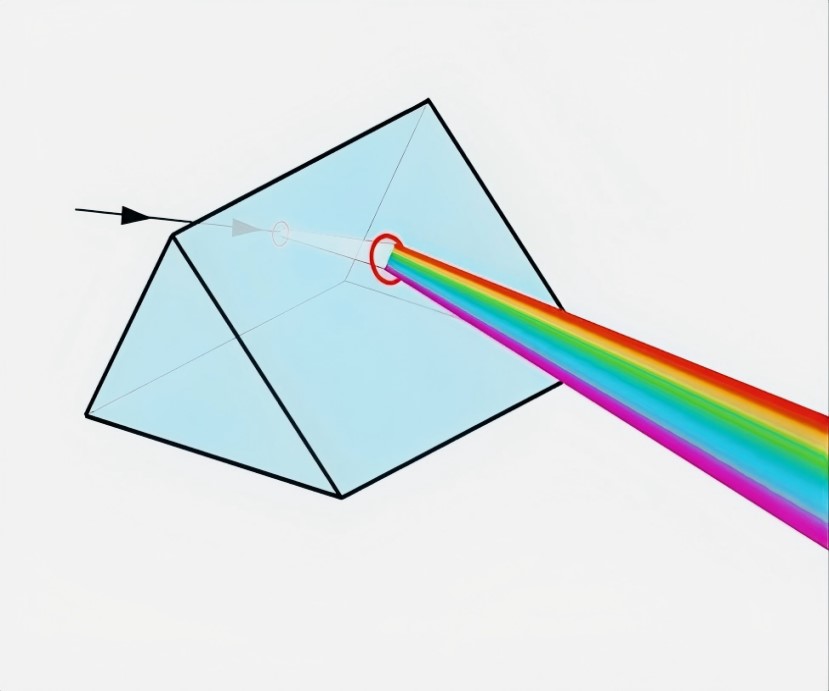
Classic Designs: The isosceles triangular prism is the most widely recognized form among the general public. In industrial applications, however, prisms come in a rich variety of geometries—right-angle prisms, pentaprisms, wedge prisms, and more—all serving distinct roles in optical path management.
In one sentence: Prisms function like “optical overpasses,” enabling light beams to change direction with exceptional precision and minimal loss.
2.The Dual Nature of Prisms: Reflection and Dispersion
Prisms fulfill two fundamentally different functions within optical systems—functions that serve as the primary criteria for engineers during component selection:
- Optical Path “Relocators” (Reflection and Beam Steering)
Leveraging total internal reflection, prisms efficiently fold or redirect light paths at standard angles—such as 90° or 180°.
Advantages: Unlike coated mirrors, prisms achieve reflection entirely within the bulk material—eliminating concerns about coating degradation, offering high laser-damage thresholds, and introducing negligible polarization effects.
Typical Applications: Periscopes, pentaprisms in DSLR cameras, laser gyroscopes. - Spectral “Artists” (Dispersion and Spectral Separation)
Due to wavelength-dependent refractive indices—the dispersion effect—white light incident on a prism fans out into a continuous, rainbow-like spectrum.
Advantages: Delivers smooth, uninterrupted spectral output without overlapping diffraction orders.
Typical Applications: Spectrometers, monochromators, color calibration in projectors. - Three Golden Rules for Prism Selection
Selecting the right prism for your system involves more than just appearance and structural compatibility—three critical parameters must be carefully evaluated:
Abbe Number of the Material
When prisms are used for imaging or beam steering (not for beam splitting), lower material dispersion is preferable—i.e., a higher Abbe number. For instance, BK7 glass (Abbe number = 64.2) outperforms standard crown glass in this regard.
Surface Flatness
Prisms employed in optical interferometers or laser resonators typically require surface flatness of λ/10 or better; for general-purpose beam steering, λ/4 flatness is usually sufficient.
Chamfering and Coating
Although prisms operate primarily via total internal reflection, non-optical surfaces are commonly blackened to protect edges and suppress stray light. Anti-reflection (AR) coatings can be applied to optical surfaces to further minimize reflection losses and maximize overall transmission efficiency.
4. Application Domains: From the Deep Sea to Deep Space
Compact in size yet indispensable in function, prisms underpin a wide array of optical instruments enabling humanity’s exploration of the world—and beyond.
Biomedical Imaging: Miniature prisms integrated into endoscopes redirect imaging light paths into confined anatomical cavities.
Aerospace: Star trackers incorporate prism assemblies to assist satellites in precise attitude determination and calibration in orbit.
Industrial Automation: Beam-shaping prisms in LiDAR systems define and optimize the device’s field of view for accurate sensing and mapping.
Conclusion
As architects of the optical path, prisms deliver exceptional stability and optical performance—ensuring reliable, consistent light transmission across diverse high-precision instruments. Whether guiding high-power laser beams in industrial processing or enabling ultra-precise spectral analysis, the right prism is fundamental to system integrity and performance.
Tianjin Fushi Optics offers comprehensive prism manufacturing services—including custom fabrication from UV-grade fused silica, IR crystals, and other specialized materials. We support angle customization, precision optical coatings, and high-accuracy cemented prism assembly—tailored to meet the unique demands of any application.