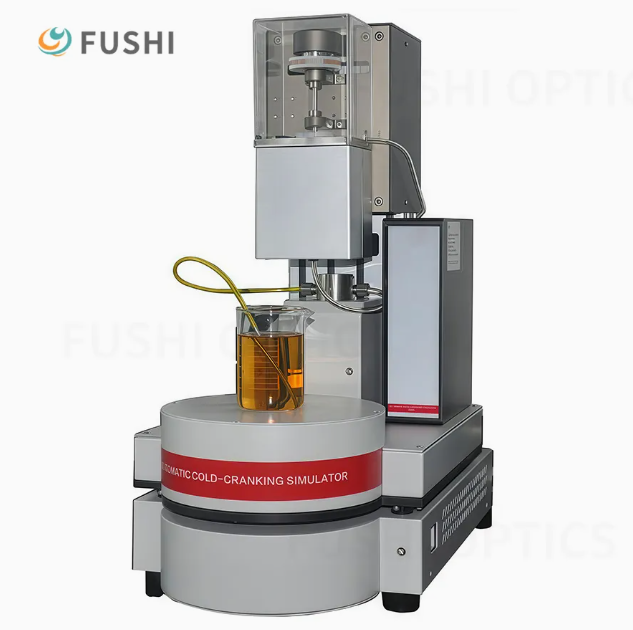
Automatic Cold Cranking Simulator (CCS)
Cold Cracking Simulator (CCS) is an instrument specifically designed to simulate the performance of lubricating oil during engine start-up in low-temperature environments. It is mainly used to test the fluidity and pumpability of engine oil under low temperature conditions, which are crucial for ensuring that the engine can start smoothly in cold weather. Widely used in fields such as automobiles and construction machinery, it is one of the key equipment for evaluating the quality of engine oil.
Measure the apparent viscosity of engine oil using the Cold Start Simulator (CCS) method. Automatic cold cranking simulator can be tested within a temperature range of -10 ℃ to -35 ℃ and is suitable for engine oils with an apparent viscosity between 900mPa. s and 25000mPa. s
Application area:
1. Lubricating oil industry: Cold cranking simulator is an essential tool for the research and quality control of lubricating oil production enterprises. By using a cold start simulator, it is possible to test the performance of different formulations of engine oil at low temperatures, optimize the formulation of lubricating oil, and ensure that it can provide good lubrication and protection for the engine in cold weather conditions.
2. Automotive manufacturing and maintenance industry: When choosing engine oil, car manufacturers need to conduct cold start simulator testing to ensure that the selected oil can meet the usage requirements of the car in different regions (especially cold regions). Car repair shops can also use this instrument to test the performance of engine oil and provide reasonable oil change suggestions for car owners.
3. Petrochemical product quality supervision department: Used to conduct quality supervision and testing of engine oil sold in the market, ensuring that the products meet relevant standards and quality requirements, and protecting consumer rights and interests.


|
Applicable standards
|
GB/T6538, ASTM D2602, ASTM D5293
|
|
Refrigeration method
|
Semiconductor refrigeration, can quickly test any temperature
|
|
Circulation method
|
Multi-function universal steel pump
|
|
Temperature control mode
|
digital display PID temperature controller
|
|
Detection method
|
Automatic injection, automatic cleaning, and automatic testing
|
|
Result processing
|
Automatic storage, printing
|
|
Temperature control range
|
-5℃ -10℃ -15℃ -20℃ -25℃ -30℃ -35℃
|
|
Working power supply
|
AC220 V, 50Hz
|
|
Working unit
|
1 unit
|
|
Temperature control accuracy
|
±0.02℃
|
FEATURES
1. Automatic testing of rotating speed, control current, and reduce human error.
2. It adopts an imported motor drive, high precision.
3. It adopts the semiconductor refrigeration system, which can rapidly test any temperature.
4. Automatically calculate the result after correction by standard oil.
5. Computer control, Windows operating system, and printer can be connected to print results.
6. It adopts the improved rotor, low torque test state, and high repeatability.
7. Automatically generate calibration curves, direct display of test viscosity results.
8. All test procedures are fully automatic control without manual operation, automatic stop and heat up after the test.
9. The instrument automatically recommends the cooling temperature.
10. The rotary encoder detects speed.
11. Viscosity measurement range: 1,500~25,000CP.
12. It can edit 20 kinds of standard oil results.
13. Equipped with a dedicated low-temperature chiller.
14. It can automatically calculate the calibration deviation of standard oil and help users check the accuracy of calibration data.
2. It adopts an imported motor drive, high precision.
3. It adopts the semiconductor refrigeration system, which can rapidly test any temperature.
4. Automatically calculate the result after correction by standard oil.
5. Computer control, Windows operating system, and printer can be connected to print results.
6. It adopts the improved rotor, low torque test state, and high repeatability.
7. Automatically generate calibration curves, direct display of test viscosity results.
8. All test procedures are fully automatic control without manual operation, automatic stop and heat up after the test.
9. The instrument automatically recommends the cooling temperature.
10. The rotary encoder detects speed.
11. Viscosity measurement range: 1,500~25,000CP.
12. It can edit 20 kinds of standard oil results.
13. Equipped with a dedicated low-temperature chiller.
14. It can automatically calculate the calibration deviation of standard oil and help users check the accuracy of calibration data.