
A diffraction grating is an optical component composed of numerous parallel, equally spaced, and equally wide slits (or grooves). Owing to its distinctive optical properties, it plays a pivotal role across diverse scientific and technological domains—particularly in spectroscopic analysis, where it provides robust technical support for compositional analysis of materials and astronomical observations.
Fundamental Principle of Gratings
The core operating principle of diffraction gratings relies on the combined effects of optical diffraction and interference. When monochromatic, collimated light illuminates a grating, each slit generates a diffracted wavefront; these wavefronts from adjacent slits then interfere constructively or destructively, producing alternating bright and dark fringes. The angular positions of the bright fringes (principal maxima) obey the grating equation:
d sin θ = mλ (m = 0, ±1, ±2, …),
where d denotes the grating constant (i.e., groove spacing), θ the diffraction angle, λ the wavelength of incident light, and m the diffraction order.
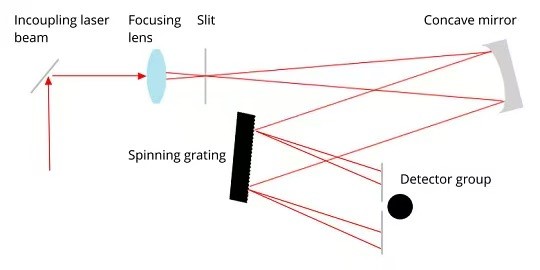
When polychromatic light passes through a grating, spectral dispersion occurs: different wavelengths emerge at distinct angles, thereby separating the incident light into its constituent spectral components. For instance, sodium emission lines (~589 nm) and hydrogen Balmer-alpha lines (~656 nm) are spatially resolved onto different locations on the detector. Moreover, by tailoring groove parameters—such as width and spacing—gratings can shape optical beams, enabling applications in laser beam shaping and optical communications.
Role of Gratings in Spectroscopic Analysis
Core Dispersive Element in Spectrometers
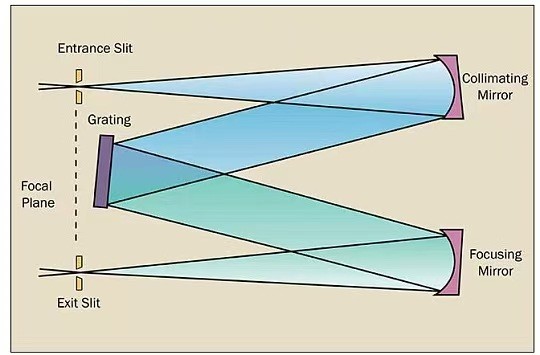
Spectrometers constitute essential instruments for spectroscopic analysis, and diffraction gratings serve as their central dispersive element. In elemental analysis, spectrometers employ gratings to decompose light emitted or absorbed by a sample into its spectrum, thereby identifying chemical elements present. Each element exhibits a unique spectral “fingerprint”; analyzing such spectral features allows precise identification—and even quantification—of elemental composition. In geological exploration, for example, spectral analysis of rock samples reveals the types and proportions of constituent minerals, offering critical guidance for mineral resource assessment and exploitation.
In astronomy, spectrometers likewise play an indispensable role. Stellar spectral analysis enables astronomers to infer fundamental stellar properties—including surface temperature, chemical composition, radial velocity, and evolutionary stage. By dispersing starlight with a grating, researchers examine absorption and emission lines embedded in the spectrum to deduce internal structure, atmospheric conditions, and nucleosynthetic history. Solar spectral analysis, for instance, has led to the discovery of numerous atomic species in the Sun’s atmosphere, furnishing vital clues about solar physics and dynamics.
Applications in Spectrographs
Spectrographs record emission or absorption spectra for archival and detailed analysis—again relying fundamentally on the grating’s dispersive capability. In materials science, spectrographs capture spectral responses of materials under varying experimental conditions (e.g., temperature, pressure, excitation source), thereby revealing insights into electronic structure, phase transitions, defect states, and functional behavior. In semiconductor research, for example, recorded spectra help determine bandgap energies, carrier concentrations, and impurity profiles—guiding synthesis optimization and device engineering.
In environmental monitoring, spectrographs detect and quantify pollutants in air, water, and soil. Spectral signatures of contaminants allow unambiguous identification and concentration estimation, supporting evidence-based environmental management. For instance, real-time spectroscopic monitoring of trace gaseous pollutants (e.g., NO₂, SO₂, ozone) in ambient air enables early detection of deteriorating air quality and timely implementation of mitigation strategies.
Advantages of Gratings in Spectroscopic Analysis
High Spectral Resolution
Gratings deliver exceptional resolving power, cleanly separating closely spaced spectral lines. This capability permits detection of minute compositional variations in complex samples. In biomedical diagnostics, for example, high-resolution spectroscopy can identify trace biomolecules—such as specific proteins or metabolites—in biological fluids or tissues, facilitating early disease detection and personalized therapeutic monitoring.
High Sensitivity
Gratings efficiently concentrate optical energy into discrete diffraction orders, significantly enhancing signal-to-noise ratios and detection sensitivity. Consequently, even ultra-low-concentration analytes become measurable. In food safety testing, highly sensitive spectral assays can reliably detect sub-ppb levels of toxins, pesticides, or adulterants—ensuring consumer protection and regulatory compliance.
Broad Spectral Versatility
Gratings operate effectively across a wide spectral range—from the deep ultraviolet (UV) through the visible (VIS) to the near- and mid-infrared (IR). This broad compatibility makes them suitable for analyzing diverse sample types and physical phenomena. In advanced materials research, for instance, UV–VIS spectroscopy probes electronic transitions, while IR spectroscopy reveals vibrational modes—jointly providing a comprehensive picture of material structure, bonding, and functionality.
Advancing Spectroscopic Analysis through the Development and Manufacturing of Diffraction Gratings
Advancements in Manufacturing Processes
As manufacturing technologies continue to evolve, the fabrication techniques for diffraction gratings have become increasingly sophisticated. Common current methods include mechanical ruling, photolithography, electron-beam lithography, and laser interference lithography. Mechanical ruling offers low cost and suitability for mass production, yet its precision is limited by mechanical vibrations. Photolithography achieves high resolution—down to the sub-micrometer scale—but involves complex procedures and higher costs. Electron-beam lithography delivers nanoscale precision, making it ideal for cutting-edge scientific research and micro/nano-optical device fabrication. Laser interference lithography enables the production of large-area, high-precision gratings, though it demands expensive equipment.
These advanced fabrication techniques continuously enhance grating quality and performance, thereby providing more powerful tools for spectroscopic analysis. For instance, high-precision gratings significantly improve the resolution and sensitivity of spectrometers, enabling more accurate identification of material composition and structural characteristics.
Development of Novel Grating Types
Beyond conventional gratings, emerging grating designs are opening new avenues for spectroscopic applications. Fiber Bragg gratings (FBGs), for example, play a pivotal role in optical fiber communications and sensing—and are also gaining traction in spectroscopy. FBGs modulate and sense optical signals; by analyzing their reflected spectra, physical parameters such as temperature and strain can be measured, offering a fresh spectroscopic approach.
Echelle gratings—characterized by exceptionally high angular dispersion—allow compact spectrometer designs, boosting both analytical efficiency and accuracy. The Changchun Institute of Optics, Fine Mechanics and Physics, Chinese Academy of Sciences, has successfully achieved mass production of echelle gratings measuring 400 mm × 500 mm, providing robust support for the advancement of spectroscopic technology.
Future Trends in Grating Applications for Spectroscopic Analysis
Integration with Other Technologies
Moving forward, grating-based spectroscopic analysis will become increasingly intertwined with complementary technologies. Integrating grating spectroscopy with artificial intelligence, for example, enables rapid, intelligent processing of spectral data—enhancing both speed and analytical reliability. Coupling it with micro/nanofabrication techniques facilitates the development of miniaturized, highly integrated spectroscopic instruments tailored to diverse application needs.
Expansion into New Application Domains
Ongoing technological progress continues to broaden the scope of grating-based spectroscopy. Beyond traditional domains such as compositional analysis and astronomical observation, this technique is poised to make significant contributions in biomedicine, environmental monitoring, and food safety. In biomedicine, it supports early disease diagnosis and real-time therapeutic monitoring; in environmental monitoring, it enables continuous, on-site detection of pollutants in air and water.
Diffraction gratings hold profound value in spectroscopic analysis. As grating fabrication technologies advance and novel grating architectures emerge, their role in spectroscopy will grow ever more pervasive and profound—equipping humanity with ever more powerful tools to understand and explore the world.