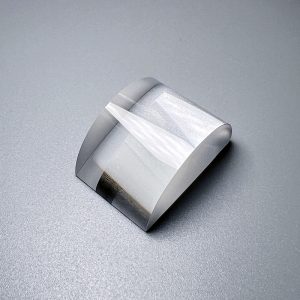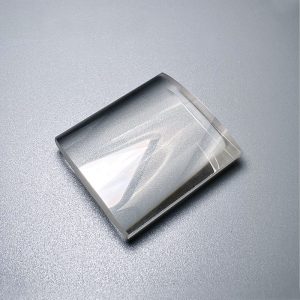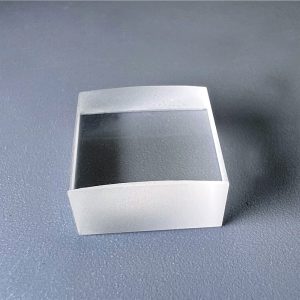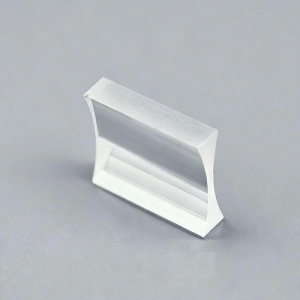
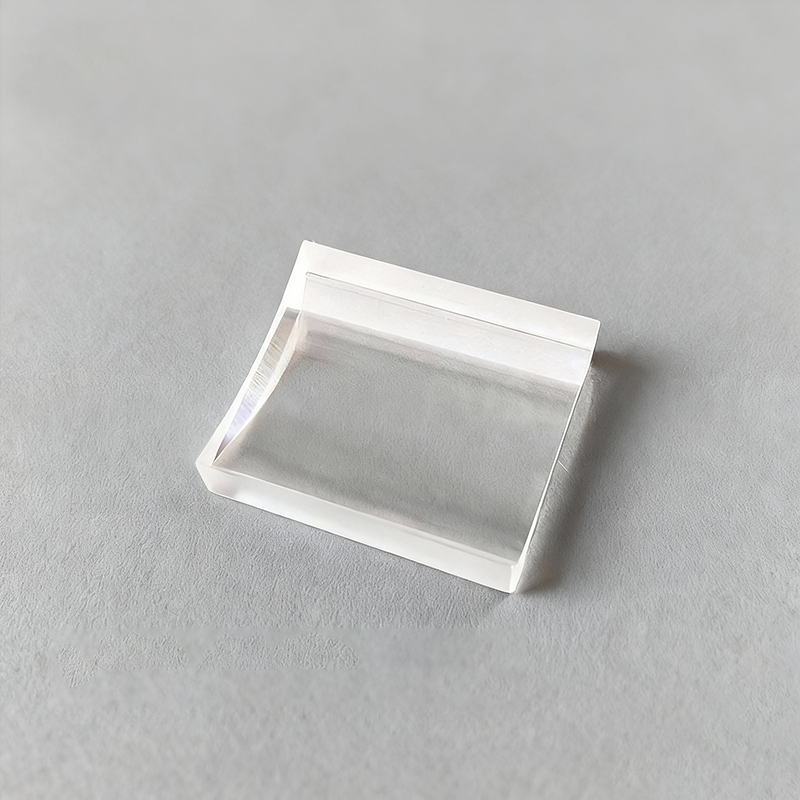
A plano-concave cylindrical lens consists of one flat surface and one concave cylindrical surface. It possesses a negative focal length and is widely used to focus collimated or divergent light beams into lines—or to adjust the aspect ratio of an image. As a type of aspheric lens, it features one planar face and one concave cylindrical face. Its primary function is beam shaping in a single dimension—enabling conversion from a point source to a line focus, or precise control over image aspect ratio.
One-Dimensional Divergence: Owing to its negative focal length, it causes incident collimated light to diverge unidirectionally—perpendicular to the cylinder’s generatrix—producing a divergent, line-shaped virtual image. This stands in sharp contrast to the converging behavior of plano-convex or biconvex lenses.
| Material | K9, fused silica, etc. |
| Diameter tolerance | ±0.02mm |
| Thickness tolerance | ±0.02mm |
| Surface figure: | λ/10 |
| Surface quality | 20/10 or better |
| Centration error | <3 arc min |
| Centration error | >90% |
| Edge bevel | <0.2X45° |
| Coating | Customizable |