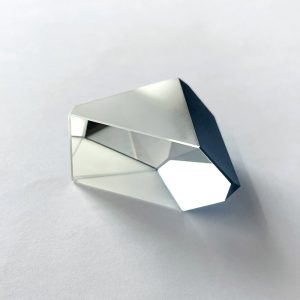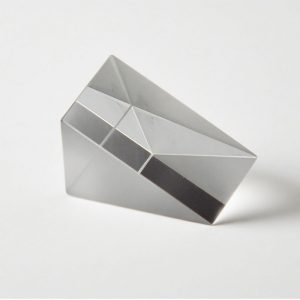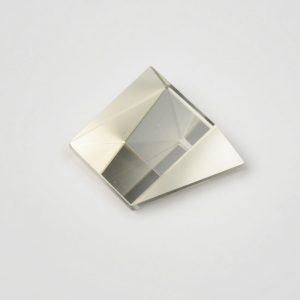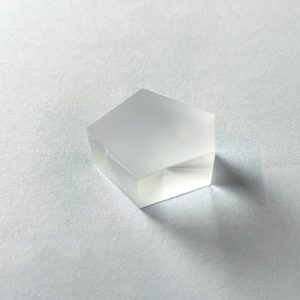
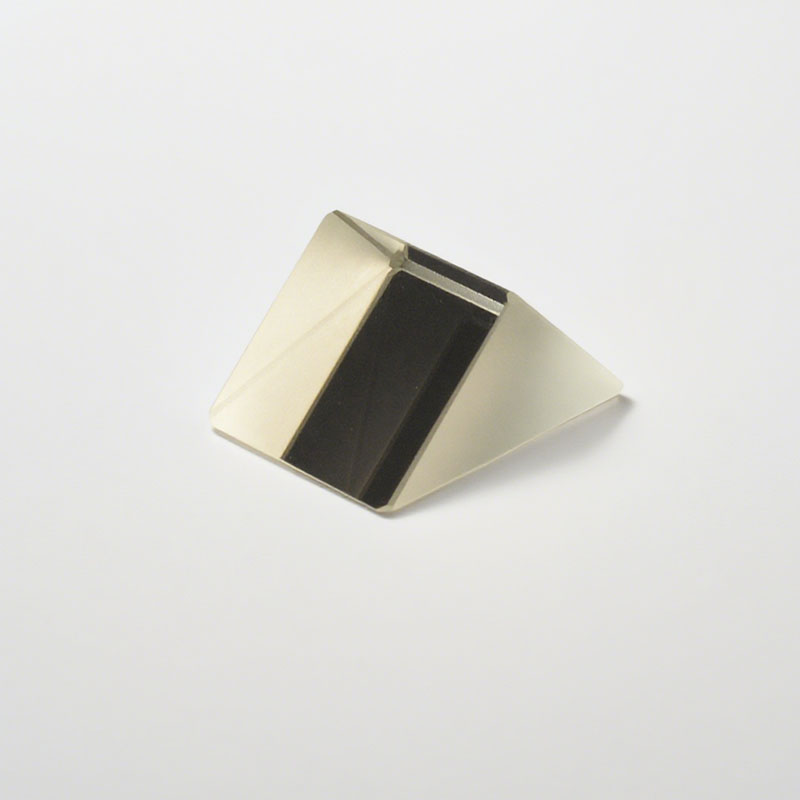
The triangular prism is the most fundamental type of prism. Relying on the principles of refraction and dispersion, it splits white light into its constituent monochromatic components—producing the familiar rainbow effect. It can also redirect light beams (e.g., by 60° or 90°) and is widely employed in spectroscopic analysis and educational demonstrations.
Specifications:
| Parameter | Details |
| Material | K9 glass, fused silica, etc. |
| Dimensions | 10×20×30mm~50×100×150mm |
| Apex Angle | 30°~60°(60° most common) |
| Surface Coating | Two faces: anti-reflection (AR) coating; one face: optional high-reflection (HR) coating |
| Function | Dispersion / beam steering |
| Operating Wavelength Range | 400–700nm(visible spectrum) |
Optical Path Diagram:

Applications:
Spectrometers
Classroom experiments (e.g., Newton’s dispersion experiment)
Artistic lighting design