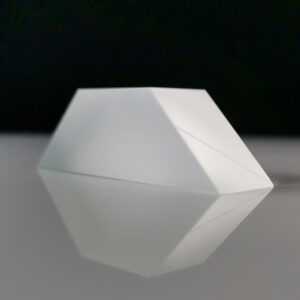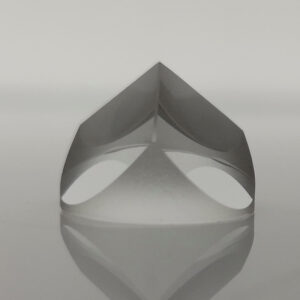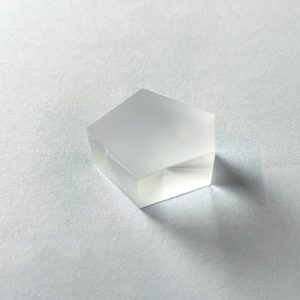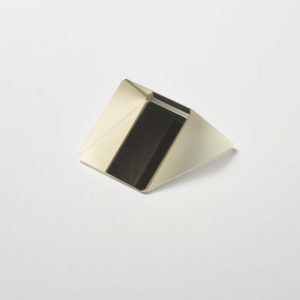
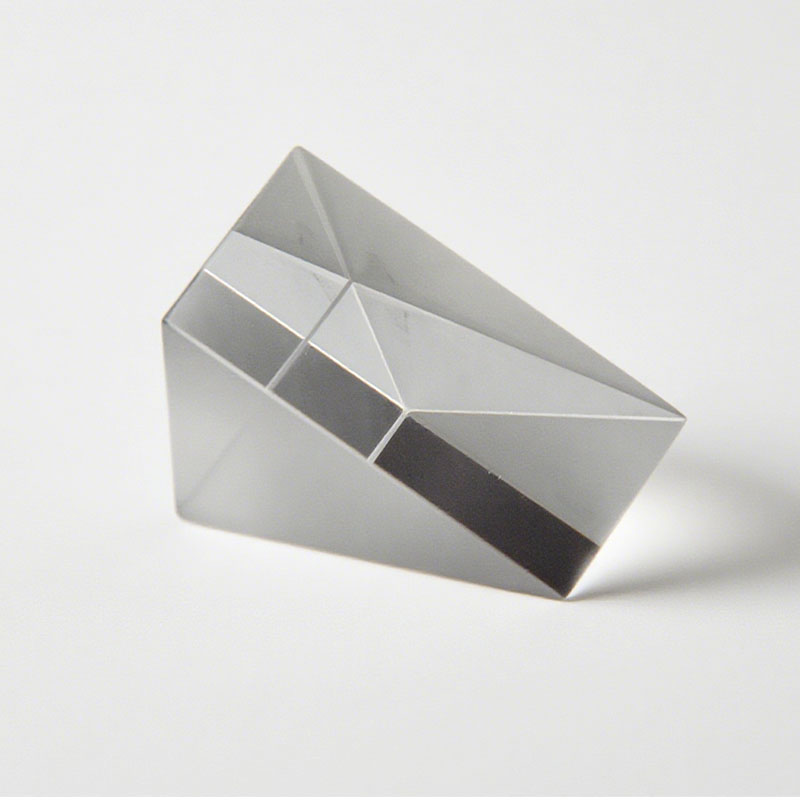
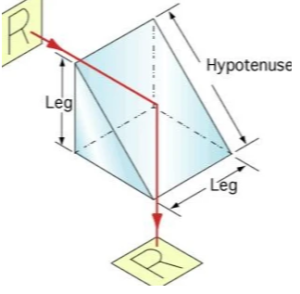
A right-angle prism operates on the principle of total internal reflection (TIR) to deflect an incident beam by either 90° or 180°. Widely employed in periscopes, telescopes, and laser systems, it enables precise beam redirection without requiring reflective coatings—offering simple mechanical design and high operational reliability.
Specifications:
| Parameter | Description |
| Material | K9 glass, fused silica, etc. |
| Dimensions | 10×10×20mm~40×40×80mm |
| Surface Treatment | Input/output faces: Anti-reflection (AR) coating |
| Hypotenuse face: Total internal reflection (no coating required) | |
| Beam Deviation Angle | 90° or 180° |
| Operating Wavelength Range | Visible to near-infrared |
Optical Path Diagram:
Typical Applications:
• Periscopes
• Laser collimation systems
• Optical metrology instruments