
In the field of optics, UV (ultraviolet) transmission gratings are pivotal optical components with far-reaching significance. They play a critical role across diverse domains—including fundamental scientific research, industrial manufacturing, and everyday applications. Below is a comprehensive and in-depth overview of UV transmission gratings.
- Fundamental Concept of UV Transmission Gratings
UV transmission gratings belong to the broader family of diffraction gratings. They are fabricated by etching numerous parallel, equidistant, and uniformly wide slits onto a transparent glass substrate. Their operation relies on multi-slit diffraction, enabling spectral dispersion of polychromatic light. While functionally analogous to conventional transmission gratings, UV transmission gratings are specifically engineered for ultraviolet radiation—endowing them with distinctive performance characteristics tailored to this spectral region.
The etched grooves act optically like ground glass: most incident UV light is scattered or absorbed and fails to transmit. In contrast, the unetched regions between adjacent grooves serve as effective transmission slits, allowing UV light to pass through. This unique architecture enables highly efficient spectral separation and manipulation of ultraviolet radiation.
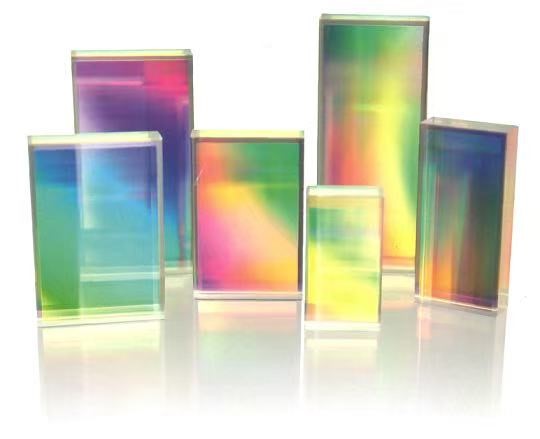
2. Operating Principle of UV Transmission Gratings
When UV light illuminates a UV transmission grating, each slit acts as a coherent secondary source, producing diffracted wavefronts according to the principles of multi-slit diffraction. Because different UV wavelengths undergo diffraction at distinct angles, spatially separated diffraction orders emerge downstream of the grating. The positions and intensities of these orders depend directly on both the incident UV wavelength and key grating parameters—most notably the grating period (i.e., the center-to-center spacing between adjacent slits).
For instance, a given UV transmission grating’s period dictates the angular separation among its diffraction orders. By precisely measuring the spatial distribution and relative intensities of these orders, one can reconstruct the spectral composition—both wavelength and intensity—of the incident UV radiation, thereby enabling high-fidelity UV spectroscopic analysis.
3. Fabrication Process of UV Transmission Gratings
Manufacturing UV transmission gratings demands exceptional precision. The process begins with selecting an appropriate transparent substrate—typically high-purity fused silica or specialized UV-grade glass—that exhibits excellent UV transmittance, superior optical homogeneity, and robust chemical stability.
Subsequently, micro- and nanoscale patterning techniques—such as photolithography and reactive ion etching—are employed to define the grating structure on the substrate surface. Photolithography allows precise control over slit width, pitch, and profile geometry to meet application-specific requirements. Etching parameters—including depth and rate—must be tightly regulated to ensure uniform slit morphology and consistent optical performance across the entire grating area.
Rigorous quality assurance is integral to the fabrication workflow. Critical metrics—including surface flatness, dimensional accuracy of slits (width, depth, and periodicity), and absolute diffraction efficiency—are systematically evaluated. Only gratings that pass stringent metrological criteria are approved for deployment in real-world applications.
4. Application Domains of UV Transmission Gratings
(A) Scientific Research
In spectroscopy, UV transmission gratings are indispensable tools. They enable detailed analysis of absorption and emission spectra in the ultraviolet range, revealing vital information about molecular structure, bonding configurations, and electronic transitions. In analytical chemistry, for example, characteristic UV absorption features allow identification and quantification of specific functional groups within complex molecular systems.
In astronomy, UV transmission gratings are essential for observing ultraviolet emissions from stars, galaxies, and other celestial objects. Spectral analysis of such UV radiation provides crucial insights into stellar temperatures, elemental abundances, plasma conditions, and evolutionary stages—thereby advancing our understanding of cosmic structure and evolution.
(B) Industrial Manufacturing
In semiconductor fabrication, UV lithography remains a cornerstone process. UV transmission gratings serve as key elements in photomask design and beam-shaping optics, enabling precise spatial control of UV illumination to transfer intricate circuit patterns onto silicon wafers. This capability underpins continued miniaturization and performance enhancement of integrated circuits.
In the printing industry, UV transmission gratings support advanced UV-curing processes. By focusing UV radiation onto targeted areas, they accelerate the polymerization of specially formulated inks—significantly improving print speed, resolution, durability, and environmental compatibility.
(C) Environmental Monitoring
In atmospheric monitoring, UV transmission gratings facilitate real-time detection and quantification of airborne pollutants. Many gaseous contaminants—including ozone, nitrogen oxides, sulfur dioxide, and volatile organic compounds—exhibit distinctive UV absorption signatures. High-resolution UV spectral measurements thus provide actionable data for air quality assessment and regulatory compliance.
In water quality analysis, UV transmission gratings enable rapid, non-invasive detection of organic contaminants and heavy metals. UV absorption spectroscopy of water samples delivers immediate, quantitative insights into pollutant loadings and temporal trends—supporting proactive environmental management and public health protection.
5. Emerging Trends and Future Directions
(I) Enhanced Spectral Resolution
As scientific inquiry and industrial metrology demand ever-greater spectral fidelity, UV transmission gratings must evolve toward higher resolving power. Achieving this requires tighter tolerances in slit fabrication—particularly in controlling linewidth uniformity, groove depth consistency, and sub-nanometer periodicity accuracy—to realize finer spectral discrimination and improved signal-to-noise performance.
(II) Larger Dimensions
In certain large-scale optical systems, UV-transmissive gratings with larger dimensions are required. Consequently, developing high-quality UV-transmissive gratings of increased size represents a key direction for future advancement—challenges such as material uniformity and fabrication complexity must be addressed to realize this goal.
(III) Integration with Other Technologies
Going forward, UV-transmissive gratings are expected to integrate seamlessly with other optical and electronic technologies, enabling more sophisticated and multifunctional optical systems. For instance, integration with detectors will support real-time spectral detection and analysis; coupling with micro- and nanoscale optical technologies will pave the way for novel optical sensors.
As a critical optical component, UV-transmissive gratings find broad application across scientific research, industrial manufacturing, and environmental monitoring. With continuous technological progress, their utility will expand into new domains, while their performance undergoes steady enhancement and refinement.